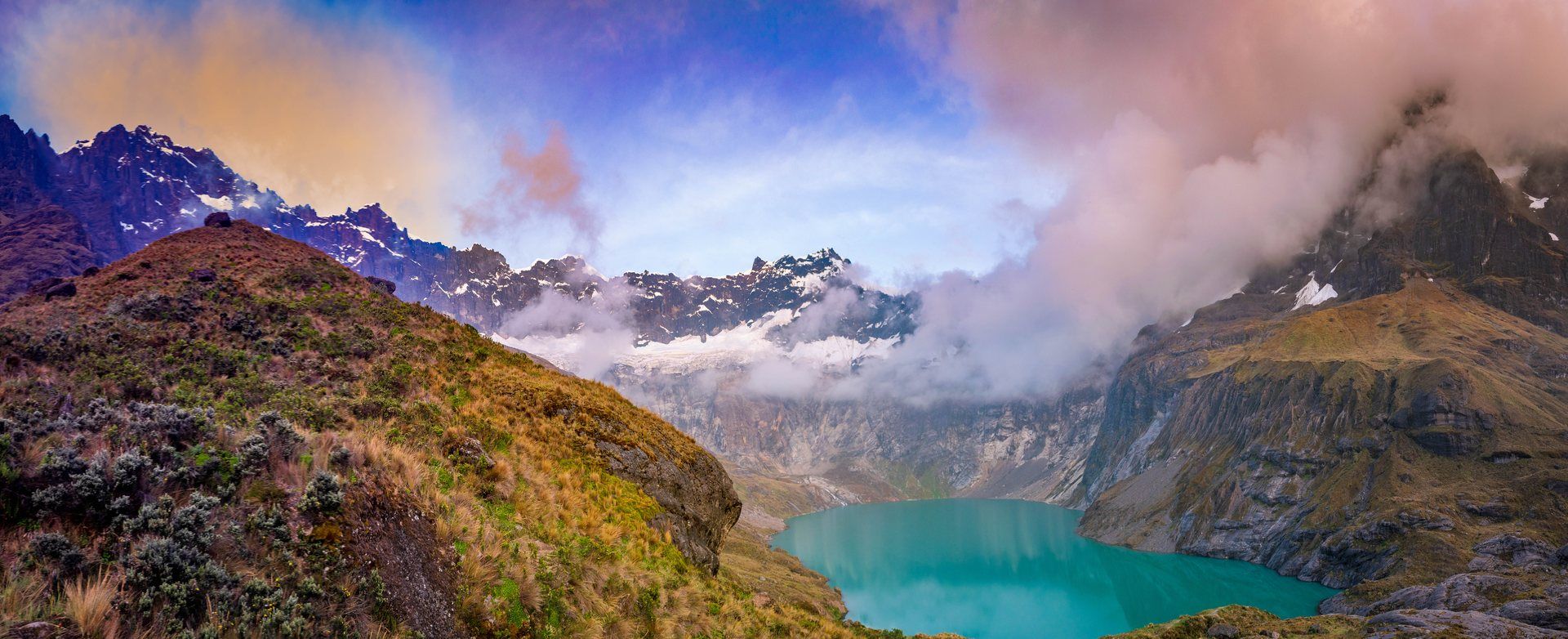
El Altar · Sangay National Park · Ecuador
The El Altar Trek, Ecuador
Three days on foot through mud and páramo into the collapsed amphitheatre of El Altar, ending above Laguna Amarilla, a crater lake at about 4,200 m under hanging glaciers.
Photo: Pablitotravel, Wikimedia Commons, CC BY-SA 4.0

What makes the El Altar trek different
The El Altar trek walks you into the remains of a volcano. El Altar, known in Kichwa as Capac Urcu, collapsed long ago and left a horseshoe of jagged peaks around a closed basin. Laguna Amarilla lies at the bottom, about 600 m long and fed by meltwater. Despite the name (amarilla means yellow), the water tends to look green, turquoise or grey, depending on the light.
You don't climb the peaks, which are serious technical objectives: El Obispo, the highest at 5,319 m, wasn't climbed until 1963. You walk through Sangay National Park, a UNESCO World Heritage site, along the Collanes valley and up to the rim above the lake. No ropes are needed, but the last stretch is steep and rocky, and one short section takes hands as well as feet.
This is no longer an empty trail. Visits grew after the pandemic, and on one August weekend in 2023 the ministry reached its visitor cap and turned away anyone who hadn't registered. Go midweek if you can. Compare it with other multi-day hikes in Ecuador, and read our acclimatization guide before you book.
Mud, weather and closures on the Collanes trail
El Altar sits in a wet corner of the Andes, and the trail to Collanes is known for mud, sometimes up to the knee. Rain also closes the route: the ministry shut it in February 2025, May 2026 and July 2026, reopening only after rangers checked the path. In June 2024, 36 visitors were stranded by bad weather in the Collanes valley and rescued the next day. We aim for December to February, bring rubber boots and often use horses for the approach, but no month is safe from rain. Leave a spare day in your trip, and we'll check the park notices with you before you travel.
Your itinerary
The classic 3-day El Altar trek
Drive from Riobamba through Penipe to Releche and sign in with the ministry and Hacienda Releche (ascents start between 8:00 and 11:00). The trail climbs 10–12 km through mud, quishuar forest and páramo, gaining about 1,000 m. Allow 5–8 hours on foot, or ride a horse. Night at the Capac Urcu refuge (about 3,840 m) or in a tent.
A steep walk of about 3.4 km and 400 m of ascent, usually 1.5–2.5 hours, to the rim above Laguna Amarilla, with the ring of peaks and hanging glaciers in front of you. Condors are possible here, never promised. Back down to Collanes for a second night.
Retrace the route down to Releche through the páramo and forest, and drive back to Riobamba. Expect the same mud on the way out.
El Altar trek altitude
The trek runs between about 3,100 m and 4,200 m, high enough that one or two nights in Riobamba or Quito beforehand make it far more enjoyable:
- Riobamba: 2,750 m
- Releche: 3,100 m
- Capac Urcu refuge, Collanes: 3,840 m
- Laguna Amarilla: 4,200 m
What's included
Included
- Trekking guide for the full route
- Capac Urcu refuge stay or camping gear
- Horses for the approach (optional)
- Park registration & private transport
- Meals on the trek
Not included
- International flights and city hotels
- Travel insurance (recommended)
- Personal hiking gear and rubber boots
- Guide gratuities
Gear
We arrange
- Guide & route logistics
- Tents or refuge + camp kitchen
- Pack horses for the approach
- Park registration & transport
You bring
- Rubber boots or very waterproof boots
- Full rain shell & warm layers
- Warm sleeping bag
- Gaiters for the mud
- Daypack & 2 L water
- Headlamp & sun protection
Safety on the mountain
- Guides who know the Sangay region
- Small groups, remote-wilderness experienced
- Horse support for the approach & gear
- Weather-flexible itinerary (mud/rain dependent)
El Altar trek FAQ
How hard is the El Altar trek?
Moderate to challenging. The altitude is not extreme (it tops out around 4,200 m). The difficulty comes from the distance, the mud and a steep, rocky final section with a short scramble. Good fitness and waterproof boots matter more than technical skill.
How long is the El Altar trek?
About 14 km each way from Releche to the lake, with roughly 1,270 m of ascent. GPS tracks vary, so plan for 25–30 km return. Most of that is the 10–12 km to the Collanes valley; the lake is about 3.4 km beyond it.
How many days is the El Altar trek?
We run it as a 3-day trek: in to Collanes, up to Laguna Amarilla and back to the refuge, then out. Some operators do it in 2 days, which makes the second day 8–10 hours. A day trip isn't realistic, because ascents start no later than 11:00 and the walk to the refuge alone takes 5–8 hours.
Can you climb El Altar?
El Altar's peaks, led by El Obispo at 5,319 m, are serious technical climbs for experienced mountaineers only. Nearly all visitors do the multi-day trek to Laguna Amarilla, which needs no technical skills, only trekking fitness.
Do you need a permit for El Altar?
Entry to Ecuador's protected areas is free under the ministry's general rule, but El Altar needs registration. The La Candelaria parish asks visitors to request an SIB record by email ([email protected]) 5 days ahead, then sign in with the ministry and at Hacienda Releche. We handle this for our groups.
Do you need a guide for El Altar?
Sources disagree, and we couldn't find a ministry document that settles it for this route. The general rule asks for a guide from 16 people up, but Ecuadorian press reported in 2025 that entry was only possible with agencies and certified guides, and after a closure that February the ministry reopened the route only to accredited operators. If you plan to go independently, ask the park in writing first.
Is the El Altar trail ever closed?
Yes. Rain closed it in February 2025, May 2026 and July 2026, and a mountain race closed it on 24–25 October 2026. Check the Ministry of Environment's notices a few days before you travel, and leave a spare day if you can.
Where is El Altar?
In Sangay National Park, Chimborazo province, central Ecuador. The trek starts at Releche, about 41 km from Riobamba through Penipe and La Candelaria. Riobamba is about 210 km from Quito, under 5 hours by road.
What is the best time to trek El Altar?
We prefer December to February, and Rough Guides suggests November to February, but La Prensa recommends July to November, and rain closed the route in both February 2025 and July 2026. Expect mud and changeable weather in any month.
Why is it called Laguna Amarilla?
Local sources disagree. The La Candelaria parish links the name to a past landslide, and Riobamba's tourism office to minerals in the water. In person it tends to look green, turquoise or grey rather than yellow.
Trek into the El Altar caldera
Tell us your dates and fitness and we'll arrange the guide, the horses and the refuge or camp, so you can walk into El Altar and stand above its crater lake.